
ArticleFiled 18 NOV 2026
Dancehall Riddims of the 2000s: Diwali, Masterpiece and More
9 min read Riddim World Reads
A selector’s guide to 2000s dancehall riddims: how Lenky’s Diwali changed the decade, what came next, and how to trace any 2000s cut to its riddim, tempo and key.
Key points
- Diwali, produced by Steven “Lenky” Marsden for 40/40 Productions, came out as Greensleeves Rhythm Album #27 on 21 May 2002.
- Sean Paul’s “Get Busy” was the big Diwali song left off the Greensleeves album, released on VP/Atlantic on 27 January 2003.
- Lenky followed Diwali with the Masterpiece riddim, issued as Greensleeves Rhythm Album #34 on 10 December 2002 with Sean Paul’s “Ever Blazin'”.
- Riddim World lists the 2004 Rudie Riddim from Gerry Parchment and Neil Perch, with cuts from Alton Ellis, Beenie Man and Bunji Garlin.
The 2000s were the decade dancehall riddims went global, and the Diwali riddim, built by Steven “Lenky” Marsden and released on Greensleeves in 2002, is the one that defines it. If you searched for dancehall riddims from the 2000s, you probably want three things: which riddims mattered, who made them, and which songs sat on them. This guide covers the decade’s anchor riddims, how the one-riddim juggling worked, a 2004 riddim you can browse cut by cut on Riddim World, and why the voices of that era are still turning up on new riddims in 2026.
What Made 2000s Dancehall Riddims Different
Dancehall has always been built on shared instrumentals, but the 2000s pushed the riddim system to its peak. A producer would build one backing track, voice it with a dozen or more deejays and singers, and release the cuts as singles. Selectors then played those cuts back to back as a juggling, so a crowd could hear five artists ride the same bassline in five minutes.
The London label Greensleeves turned that habit into a product with its numbered Rhythm Album series: one riddim per album, every major cut in one place. For fans outside Jamaica, those albums were often the only way to own a whole riddim rather than chasing pre-release seven-inches.
The sound itself shifted too. Early-decade riddims leaned on sparse drum programming, handclaps and odd, catchy synth or sample hooks that stood out on radio as much as in a dance. That clarity helped the music cross over. By the end of the decade, a new wave of deejays such as Vybz Kartel, Mavado and Busy Signal dominated the riddims coming out of Kingston, and producers were releasing riddims faster than ever.
What ties the decade together is the juggling format. If you want to understand any 2000s hit, start by asking which riddim it was on and who else voiced it. That is exactly the question the Riddim World song finder is built to answer.
Diwali Riddim (2002): The Riddim That Defined the Decade
The Producer and the Long Wait
Steven “Lenky” Marsden was born in 1971 and grew up around Windward Road in East Kingston. He spent years as a musician and sideman before starting his own label, 40/40 Productions. He first shopped the Diwali backing track around in 1998, and at the time nobody understood it. The off-kilter handclap pattern and bright melodic line did not sound like anything else on offer.
Four years later it was everywhere. Lenky also did something unusual: rather than hand every artist the same file, he overdubbed the riddim into different versions to suit each voice. That is part of why the cuts feel so distinct from one another.
The Greensleeves Album
Greensleeves Rhythm Album #27: Diwali came out on 21 May 2002. Voicings associated with the riddim come from Beenie Man, Elephant Man, Cecile, Anthony B, Assassin (now Agent Sasco), Wayne Marshall and T.O.K., whose “Galang Gal” credits Nailah, Nyanda and Tasha Thorbourne among its writers. Dancehall writers now rank Diwali alongside Sleng Teng and Stalag as one of the genre’s lasting classics.
“Get Busy” and the Crossover
The biggest Diwali song was not on the Greensleeves album at all. Sean Paul’s “Get Busy”, written by Sean Paul and Marsden and produced by Lenky, was released on 27 January 2003 on VP/Atlantic as part of Dutty Rock. It reached number one in Italy and the Netherlands and went top ten in eleven more countries.
A riddim nobody understood in 1998 became the sound most people picture when they think of 2000s dancehall. Patience, and the right voices, made it.
2000s Dancehall Riddim Timeline: Diwali, Masterpiece and Their Neighbours
Diwali did not arrive alone. Greensleeves was releasing rhythm albums in quick succession, and Lenky had a follow-up ready the same year. Here is the confirmed run of dates around the Diwali story, plus a 2004 riddim you can open on Riddim World today.
| Date | Release | Producer / label | Why it matters |
|---|---|---|---|
| 1998 | Diwali backing track first shopped | Steven “Lenky” Marsden | Turned down at the time |
| 21 May 2002 | Greensleeves Rhythm Album #27: Diwali | Lenky for 40/40, issued by Greensleeves | The decade’s defining riddim |
| 10 Dec 2002 | Greensleeves Rhythm Album #34: Masterpiece | Lenky for 40/40, issued by Greensleeves | Lenky’s first riddim after Diwali, with Sean Paul’s “Ever Blazin'” |
| 27 Jan 2003 | Sean Paul, “Get Busy” | Produced by Lenky, released on VP/Atlantic | Took Diwali into international pop |
| 2004 | Rudie Riddim | Gerry Parchment and Neil Perch for Nitty Gritty | Nine cuts mixing veteran singers and deejays |
Masterpiece is the riddim to reach for when you want the Lenky sound without repeating Diwali in a set. “Ever Blazin'” gave Sean Paul another Lenky-produced vehicle in the same year.
The Greensleeves series around those two albums shows how crowded 2002 was. In the numbering, Hard Drive sat just before Diwali, with a Hard Drive Pt. 2 after it, while Mad Ants came before Masterpiece and Clappas followed it. If you are building a 2002 juggling, that sequence is a useful map of what was competing for the same dances.
Rudie Riddim (2004): A Mid-Decade Juggling You Can Browse Cut by Cut
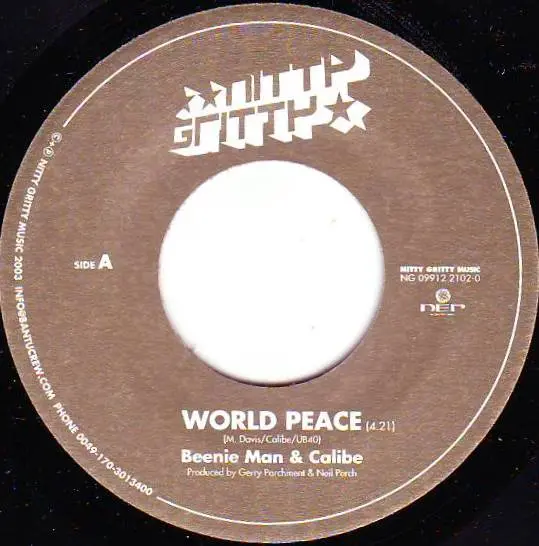
Riddim World has just added the Rudie Riddim, a 2004 release from Gerry Parchment and Neil Perch for Nitty Gritty. It carries nine cuts, and the line-up is a good snapshot of how mid-2000s riddims bridged generations.
On one side you have foundation singers: Alton Ellis with “Over And Over”, Gregory Isaacs with Don Abi on “Reason For Love”, and Jack Radics with “Take It Easy”. On the other, deejays of the moment: Beenie Man and Calibe on “World Peace” and General Degree on “I Can’t Stop Loving You”. Then there is Bunji Garlin, better known for soca, with “Helpless Child”.
That mix tells you something about the decade. Riddims were not only club tools; they were meeting places where a rocksteady legend, a dancehall star and a Trinidadian soca artist could all appear on the same instrumental. For a DJ, a riddim like this is also practical. Because every cut shares the same tempo and key, you can move from a lovers-rock vocal to a deejay tune without touching the pitch, and the crowd hears a story rather than a gear change.
We think riddims like Rudie are where 2000s digging gets rewarding. The Diwali and Masterpiece cuts are easy to find; the smaller mid-decade junglings are where you build a set nobody else is playing.
How to Find Any 2000s Dancehall Riddim and Its Cuts
Plenty of other 2000s riddims come up whenever selectors talk about the decade: names like Coolie Dance, Drop Leaf, Bookshelf, Liquid, Martial Arts and Buy Out. Credits and dates for older riddims get muddled online, so the safest route is to trace each song yourself. Here is the method we use.
- Type the song title into the Riddim World song finder. It returns the riddim the song was voiced on, even if you only know the hook.
- Open the riddim page and read the full cut list. This is your juggling: every artist who voiced the same instrumental.
- Check the producer and label line. Many 2000s riddims were licensed to more than one label, so note who built it as well as who released it.
- Note the measured BPM and Camelot key where listed. Riddims in the same or neighbouring Camelot keys blend cleanly in a mix.
- Use the riddim database to sort and filter by year, so you can see what else was released around it.
- For artist albums from the era, browse the singles and albums section, since crossover hits often appear there as well as on riddim pages.
Riddim World now catalogues 24,319 riddims and 9,329 singles and albums, from 1959 to today, and 23,964 releases carry a measured BPM and key. That depth is what lets you check a half-remembered 2000s tune against its riddim in seconds.
2000s Dancehall Voices on New Riddims in 2025 and 2026
The artists who made their names on 2000s riddims never stopped voicing. Some of the most-voiced riddims on Riddim World over the last two years carry cuts from that generation, which makes them handy bridges if you want to move a set from the Diwali years into the present.
| Riddim (year, label) | BPM | Key (Camelot) | Familiar 2000s-era voices |
|---|---|---|---|
| Hard Drive Riddim (2025, Golden Cartel Entertainment) | 93.3 | A# major (6B) | Bounty Killer, Beenie Man, Tanya Stephens, Lexxus, Harry Toddler |
| Black Widow Riddim (2025, Shines Production) | 94.8 | G# minor (1A) | Beenie Man, “Gwaan So” |
| WYFL Riddim (2026, Dj Mac Music and Crashdummy Productions) | 99.9 | C minor (5A) | Vybz Kartel, “SYM”; Mavado, “Bad & BBC Rich” |
| Hill & Gully Riddim (2026, Di Genius Production) | 99.9 | F# major (2B) | Elephant Man, “Hold Him Gyal” |
| Pull Up & Par Riddim (2026, Phat Sounds Production) | 98 | C minor (5A) | Turbulence, “Fire Light” |
| Apple Cider Riddim (2026, GusBus Records) | 106 | D# major (5B) | Busy Signal, “Gyal U No Boring”; Bunji Garlin, “Give Thanks” |
The Hard Drive listing is worth a closer look. It shares its name with the Greensleeves-era Hard Drive, and its roll call of Bounty Killer, Beenie Man, Tanya Stephens and Harry Toddler reads like a 2002 dance. Open the page and judge the cuts for yourself.
Two more connect straight back to Diwali’s line-up. Cecile, now credited as Ce’cile, voices “Bang Bang” on the Hangover & Shot A Style Riddim in G minor (6A), and Elephant Man’s Hill & Gully cut shows the same energy he brought to the Lenky era. For a modern dancehall bed at the same 99.9 BPM as WYFL, the original Wyfl Riddim listing runs to 213 cuts.
Tempo is the thing to watch. Most of today’s big dancehall riddims sit around 98 to 100 BPM, while the Hard Drive and Black Widow listings run in the low-to-mid 90s, so plan your transitions around that gap. If you want more history like this, the Riddim World articles page collects our guides to riddims, producers and eras.
Frequently Asked Questions
What is the most famous dancehall riddim of the 2000s?
The Diwali riddim is the usual answer. Produced by Steven “Lenky” Marsden for 40/40 Productions and released as Greensleeves Rhythm Album #27 on 21 May 2002, it carried Sean Paul’s “Get Busy” into international charts. Dancehall writers rank it with Sleng Teng and Stalag as one of the genre’s lasting classics.
Who produced the Diwali riddim?
Steven “Lenky” Marsden produced Diwali through his own label, 40/40 Productions. He first shopped the track in 1998, when nobody understood it, and later overdubbed different versions to suit each artist. He followed it with the Masterpiece riddim, released on Greensleeves on 10 December 2002.
What songs are on the Diwali riddim?
The best known is Sean Paul’s “Get Busy”, released on VP/Atlantic in January 2003 and the only major Diwali song left off the Greensleeves album. Other voicings come from artists including T.O.K. with “Galang Gal”, Elephant Man, Cecile, Beenie Man, Anthony B, Assassin and Wayne Marshall.
Where can I find tracklists for 2000s dancehall riddims?
Search a song title in the Riddim World song finder to see the riddim it was voiced on, then open the riddim page for the full cut list, producer and label. The riddim database lets you filter by year to see what else came out around the same time.
Because you viewed this
 Why
Is Dancehall So Sexual? Slackness, Power and the 2026
DebateArticles on Reggae & Dancehall
Music
 Reggae Artists 70s and 80s: The Names and Records
to KnowArticles on Reggae & Dancehall
Music
 Best Dancehall Songs Of The 90s: 15 Classics
RankedArticles on Reggae & Dancehall
Music
 Dancehall Culture: Music, Dance, Fashion and
Jamaican RootsArticles on Reggae & Dancehall
Music


Never miss a drop
Free Friday Riddim Drop plus alerts for the artists, producers and labels you follow. No spam. Unsubscribe anytime.