
ArticleFiled 17 NOV 2026
Dancehall Culture: Music, Dance, Fashion and Jamaican Roots
9 min read Riddim World Reads
Trace dancehall’s Jamaican foundations, understand the roles of riddims and dancers, and explore how fashion, language and community connect the culture to the music you hear today.
Key points
- Dancehall culture includes sound systems, dancing, fashion, language and community, not just a musical style.
- Older Jamaican dance spaces preceded the genre’s late-1970s emergence; Sleng Teng marked a digital breakthrough in 1985.
- A riddim supports multiple vocal recordings, making producers, selectors and contrasting performances central to how you understand the music.
- Dancers and women are cultural creators, while international adaptations extend dancehall without removing its Jamaican foundations.
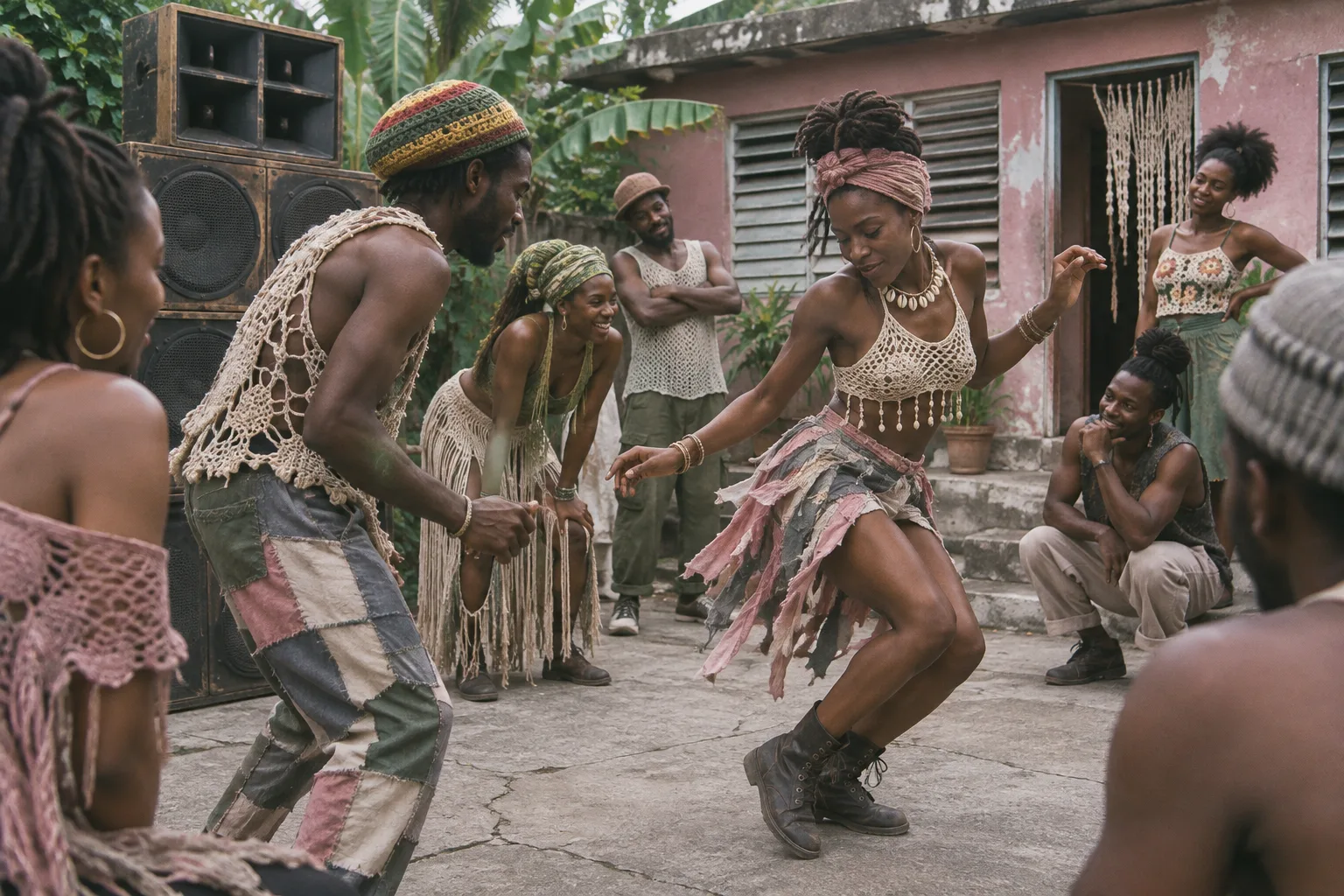
Dancehall culture is the Jamaican social world built around music, sound systems, dancing, language, fashion and community. It includes the recordings you hear, but also the people who select them, create moves, make clothes and turn a dance into a shared occasion. Its stories can address pleasure, ambition, hardship, sexuality and power, sometimes in the same performance. To understand it, you need more than a playlist of famous singers: you need to hear how the music connects with the people around it.
Where Did Dancehall Culture Begin?
Dancehall grew from Jamaican social dances and sound-system culture, especially the working-class spaces associated with Kingston. Those spaces existed before dancehall became a recognisable musical style in the late 1970s. The name therefore points both to a place of gathering and to a musical tradition.
Earlier sound-system pioneers included Tom the Great Sebastian, Clement “Coxsone” Dodd’s Downbeat and Duke Reid’s Trojan. Their dances helped establish the relationship between recorded music, vocal performance and a participating crowd. There is no single inventor or birthday for that wider culture.
U-Roy helped establish recorded toasting before the genre’s emergence; Yellowman became a major figure in its early-1980s rise. These are useful signposts, not a complete family tree.
In early 1985, Wayne Smith’s “Under Mi Sleng Teng”, produced by Lloyd “King Jammy” James, helped usher in digital dancehall. Its backing used a preset from Casio’s MT-40 keyboard. That was a digital breakthrough, not the beginning of dancehall culture itself.
Dancehall, Reggae and Soca Are Not Interchangeable
Dancehall belongs within the wider Jamaican reggae story, but its emphasis on deejay performance and dance-oriented riddims gives it a distinct identity. Reggae is not simply “slow music”, and dancehall is not defined by one tempo.
Soca has a different foundation. Trinidad’s Lord Shorty developed it through experiments combining calypso and East Indian rhythms in the 1970s.
If you move between these styles, shared performers need not mean identical traditions. The 2026 Apple Cider Riddim from GusBus Records includes Busy Signal’s “Gyal U No Boring”, Bunji Garlin’s “Give Thanks” and Fay-Ann Lyons’ “Trying”. A shared tracklist invites comparison; it does not erase the genres’ histories.
What Do Riddim, Selector and Deejay Mean?
A few terms change how you hear dancehall. In particular, the Jamaican meaning of deejay is not simply someone playing records.
- Riddim: the rhythmic backing track over which vocalists perform. Different songs can share it while changing the melody, lyrics and delivery.
- Selector: the person choosing recordings and shaping their sequence, responding to the mood and reactions of the crowd.
- Deejay: a vocal performer delivering rhythmic speech or partly sung lines, often called toasting.
- Sound system: the equipment and people presenting the music, with a history as a mobile disco and community institution.
Wayne Smith’s “Under Mi Sleng Teng”, Tenor Saw’s “Pumpkin Belly” and Johnny Osbourne’s “Buddy Bye” demonstrate the shared-riddim principle. Hearing them together directs your attention towards the vocal differences against familiar backing.
The same listening approach works now. Di Genius Production’s 2026 Hill & Gully Riddim lists 82 cuts, including Masicka’s “Slip & Slide”, Elephant Man’s “Hold Him Gyal” and Valiant’s “Woii”. A cut here means an individual recording, not a position in a chart.
Start with two performances, then listen for where each vocalist enters, leaves space or changes phrasing. You are comparing interpretations, not looking for the one “correct” version. The Riddim World riddim database lets you follow that backing beyond the first song you recognise.
Why Dance, Fashion and Language Matter
Dancehall is participatory: the crowd does not only receive the music. Dancers can give a rhythm a physical vocabulary, while crews give individual creators a platform. A move’s origin matters as much as the artist credit on a recording.
Gerald “Bogle” Levy is credited with dances including Bogle, Willie Bounce, Jiggy and World Dance. His importance shows why a history built only around singers and producers misses essential contributors. Ding Dong has described giving individual Ravers crew members opportunities to create and promote their own moves.
When you learn a routine, look for the dancer or crew behind it. Credit the creator when sharing it, and avoid treating every movement seen over a dancehall track as an established Jamaican step.
Fashion and Jamaican Language
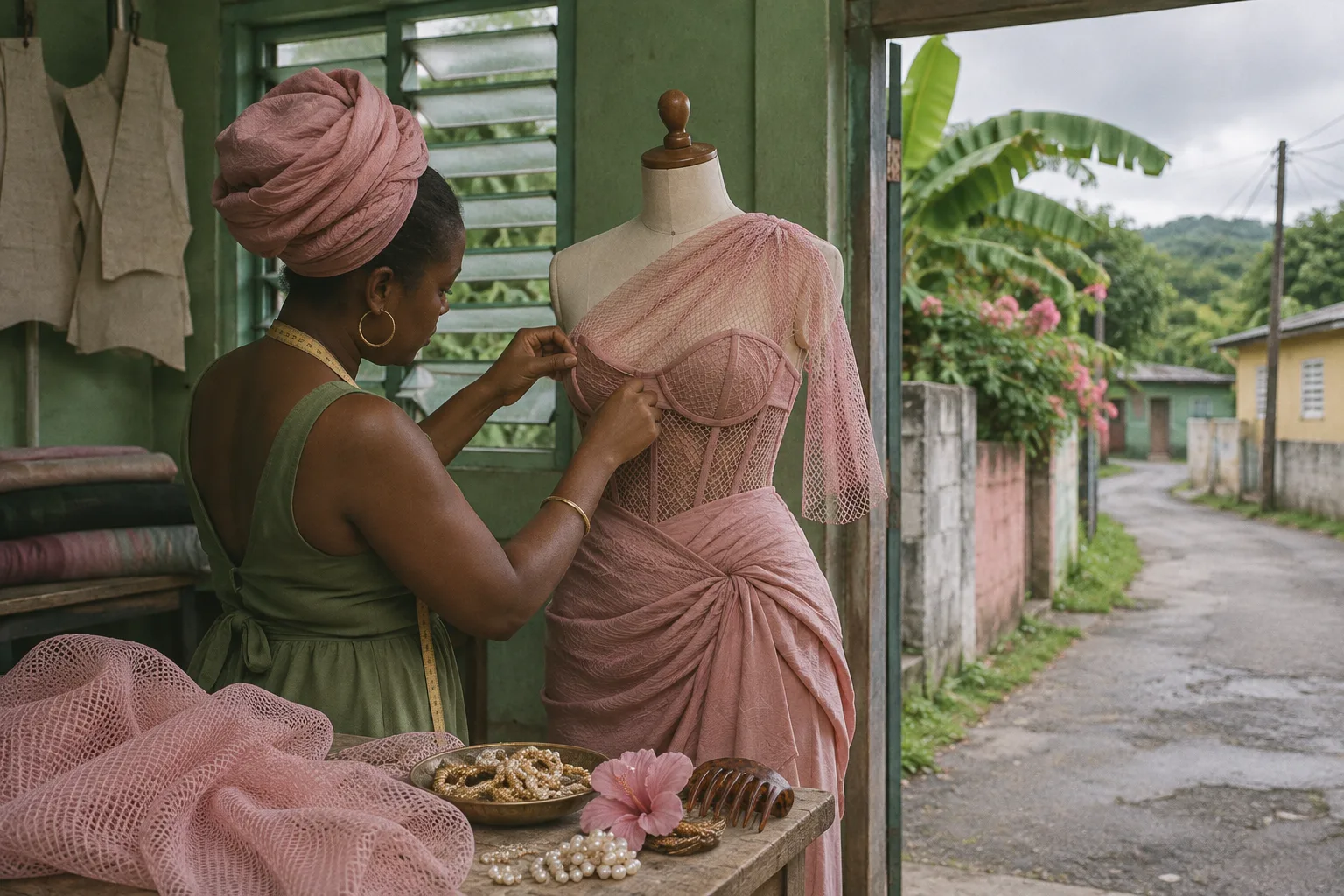
Clothing also participates in the performance. Custom-made outfits, mesh marinas, Clarks footwear, jewellery and elaborate hairstyles belong to dancehall’s fashion history. Dressmakers and patrons shape the look alongside performers; style is not simply something handed down by celebrities.
There is no single required costume. What matters culturally is the effort to make a personal statement within a shared social space.
Jamaican Patwa, also called Jamaican Creole, carries wordplay, humour, boasts and local references. It is not decorative slang to strip away from a lyric: delivery and meaning work together. If a phrase is unfamiliar, seek its context rather than assuming the most literal interpretation.
At a dance, watch before stepping into someone else’s space. Ask before filming, respect boundaries and remember that participation does not require copying another person’s identity.
Women, Sexuality and Community in Dancehall
Sister Nancy, Lady G, Lady Saw and Diana King belong within dancehall’s musical history, not in a separate footnote. Women also help make the culture through dancing, dressmaking and participation, rather than existing only as subjects of men’s lyrics.
Sexual expression can be a means of agency, pleasure or self-definition. It can also coexist with restrictive expectations and unequal power. Scholar Karen Flynn’s work on Toronto explores women’s sexual agency and empowerment while acknowledging those contradictions. No single interpretation describes every woman’s experience.
That is why neither “dancehall empowers everyone” nor “dancehall is only exploitation” gives you a useful account. Listen to who is speaking, who gets to answer, and what choices the performance allows.
A current listening route is Tight Tight Riddim, the 2026 collection from Sikk Records and MosHouse Records. Its 12 listed cuts include Queen Ladi Gangsta’s “Tight Tight”, Pamputtae’s “Ride” and Sita Lyrical’s “Pretty Pretty Me”. Use it to compare different voices rather than assuming that a shared backing produces one perspective.
You can value the culture while questioning misogyny, homophobia or the glorification of violence where they appear. Criticism should address particular lyrics and practices, not reduce Jamaican people or an entire musical tradition to stereotypes.
How Dancehall Culture Travels Worldwide
Dancehall’s international reach includes the United States, Britain, Canada, Japan and continental Europe. Recordings travel, but so do ways of selecting music, performing vocals, dressing and organising a dance. A local scene can adapt those practices without becoming interchangeable with Jamaica.
Sean Paul’s Dutty Rock, on VP/Atlantic, won Best Reggae Album at the 2004 Grammy Awards. That is an accessible crossover milestone, but an award tells you less about everyday participation than following the people sustaining a scene.
Institutions examine that wider cultural history too. MCA Chicago’s “Dancing the Revolution: From Dancehall to Reggaetón” ran from 14 April to 20 September 2026, exploring dancehall’s visual, political and spiritual histories. Its approach is a reminder that music history also lives in images and social spaces.
For your own listening, move beyond the same handful of crossover names. DJ Inno Music Studio Recordings’ 2026 Magunanzi Riddim has 50 listed cuts, while the 2025 DanceHall Remedy Riddim, produced by Levels for Chillspot Records, has 35. Follow their artist credits and compare vocal approaches rather than treating international dancehall as one uniform sound.
Dancehall Riddims to Explore in 2026
You can hear the shared-riddim format across current collections without making chart claims. These 2025–2026 catalogue entries offer different producers and vocal line-ups; cut totals describe listed recordings, not sales or popularity.
| Riddim and Year | Producer / Label | Listed Cuts | BPM and Key |
|---|---|---|---|
| Wyfl Riddim — 2025 | Dj Mac Music and Crash Dummy | 213 | 99.9 — C minor (5A) |
| Hard Drive Riddim — 2025 | Golden Cartel Entertainment | 41 | 93.3 — A# major (6B) |
| Story Book Riddim — 2025 | Rvssian of Head Concussion Records | 40 | 90.1 — F minor (4A) |
On Hard Drive, compare Bounty Killer’s “How Dem A Live So” with Beenie Man’s “Greatest Of All Time”. The shared backing gives you a practical way to focus on each vocalist’s delivery.
Keep similarly named entries separate. The linked 2025 Wyfl listing contains 213 cuts; the 2026 WYFL Riddim album entry lists 45, including Skippa’s “WYFL”, Vybz Kartel’s “SYM” and Mavado’s “Bad & BBC Rich”. Both entries are measured at 99.9 BPM in C minor, but their listed totals differ.
Use tempo and key as navigation aids, not definitions of dancehall. Camelot labels such as 5A give DJs a quick harmonic reference, but matching values cannot tell you how two vocals will sit together. Rhythm, phrasing and context still need your ears.
For a newer entry, Supa Hype Music and Ram Jam’s 2026 Beg Yu Pardon Riddim was posted on 14 November 2026. Its 13 cuts include Future Fambo’s “Beg You Pardon” and Shawn Storm’s “As A Gallis”; its measured tempo and key are 103.3 BPM and G minor (6A).
Choose one song, find its backing, then listen to another voice on the same riddim. That simple comparison connects the recording to a collective practice. If you only know the title, the Riddim World song finder is a natural place to start.

Frequently Asked Questions
What is dancehall culture?
Dancehall culture is a Jamaican cultural tradition encompassing music, sound systems, dance, fashion, language and community life. It includes the relationships between performers, producers, selectors, dancers and audiences. Its significance extends into identity, sexuality and politics, rather than stopping at the recordings.
Where did dancehall culture originate?
Dancehall culture grew from Jamaican social dances and sound-system traditions, especially those associated with Kingston’s working-class communities. Those foundations preceded dancehall’s emergence as a musical style in the late 1970s. No single person invented the entire culture.
Is dancehall the same as reggae or soca?
Dancehall belongs to Jamaica’s wider reggae history but has a distinct musical and performance tradition. Soca developed separately in Trinidad through Lord Shorty’s experiments combining calypso and East Indian rhythms in the 1970s. Shared artists or overlapping tempos do not make the genres interchangeable.
What is a riddim in dancehall music?
A riddim is the rhythmic backing track over which vocalists perform. Multiple songs can use the same riddim while featuring different lyrics, melodies and vocal approaches. Listening to several cuts together helps you hear how each performer interprets the shared backing.
Why are dance and fashion important in dancehall?
Dancers create movements that become part of the culture, while dressmakers and patrons shape its visual identity. Bogle’s credited dances, including Willie Bounce and World Dance, show why dancers belong alongside musicians in its history. Fashion and movement let participants contribute rather than remain passive spectators.
Because you viewed this
 Best Dancehall Songs Of The 90s: 15 Classics
RankedArticles on Reggae & Dancehall
Music


Never miss a drop
Free Friday Riddim Drop plus alerts for the artists, producers and labels you follow. No spam. Unsubscribe anytime.