

Artist · producer · label
Junior Demus
39 releases
Junior Demus is a Jamaican dancehall deejay whose name turns up in the music around the early 1990s, when his gravelly delivery and loose, joking style fit squarely into the raw energy of the era. He is best known as part of the hard-edged dancehall wave that blurred the line between streetwise chatter, quickfire rhythms, and playful crowd command, and his work has remained a familiar reference point for fans of classic digital-era Jamaican music. Sources and discographies consistently place him among the artists active in that period, with recordings that helped define the sound of the time rather than chase crossover polish.
Read the full profile
His catalog shows a performer who moved comfortably between solo cuts and high-profile combinations. Songs such as “When Me Come,” “One Master,” and “Good Over Evil” are often cited among his better-known titles, while “Cabin Stabbin” became one of the standout collaborative cuts associated with his name. He also appeared on releases alongside major dancehall figures including Super Cat and Nicodemus, which helped position him within one of the scene’s most recognisable circles. That kind of company matters in dancehall: it signals an artist trusted to hold his own on a rhythm and contribute to the chemistry of a bigger record.
What gives Junior Demus lasting appeal is the character in the performance. His style is often described as rough-voiced and unvarnished, but that toughness is part of the charm. He came out of a generation that valued personality as much as technique, and he used that approach to deliver lines with wit, timing, and a sense of street-level realism. He never needed elaborate production to make an impression; the voice itself carried attitude.
Later reissues and compilation appearances have kept his name circulating for new listeners digging into dancehall’s early-90s stretch. Releases tied to his catalog, including the album Bad Fowl and the group project The Good, the Bad, the Ugly and the Crazy, show how his work sat between solo identity and collective dancehall culture. In that sense, Junior Demus represents a familiar but important figure in Jamaican music: an artist whose strength lies not in spectacle, but in a distinct voice that helped shape the feel of a moment.
Sources: allmusic.com, musicbrainz.org, reggaeone.blogspot.com · Profile updated 8 Apr 2026
Releases

Answer 2k1 Riddim
Ras- I Records93 BPM · 9B
Ba Ba Boom Riddim
Various Labels
Bad Boy Skank Riddim
Hipower Music93 BPM
Bam Bam Riddim
Various Labels95 BPM · 7A
Big Bump Riddim
Ujama74 BPM · 11B
Cabin Stabbin Riddim
Wild Apache85 BPM · 8B
Consignment Riddim
Black Scorpio76 BPM · 9B
Crash Riddim (1999)
Greensleeves Records94 BPM
Dance Nice Riddim Aka Its Raining (2001)
Ras I Records93 BPM · 9B
Dancehall Machine Riddim
Riddim World Records94 BPM · 3A
Death In The Arena Riddim
Various Labels85 BPM · 10B
Detergent Riddim / Soap Riddim (1991)
Digital B
Discipline Riddim
Super Supreme86 BPM · 4A
E Drop Riddim
Various Artists84 BPM · 5A
Freedom Door Riddim
Parish
Gun Talk Riddim
Shellys Records96 BPM · 11B
Kuff Riddim
Various Labels1B
Level The Vibes Riddim
Various Labels
Love Is Not A Gamble Riddim
Various Labels78 BPM · 9B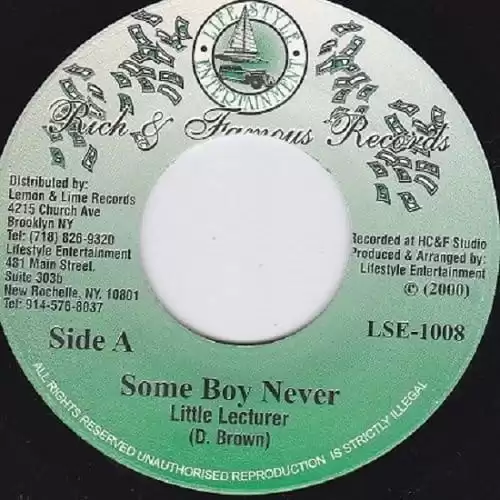
Millenium Riddim (2000)
Rich And Famous Rec97 BPM · 1B
Mr Bassie Riddim
Various Labels78 BPM · 8A
Mud Up Riddim (1990)
Skendon All Stars93 BPM · 2B
Mud Up Riddim (2001)
IN The Streetz93 BPM
Nanny Goat Riddim
Tappa Records81 BPM
Pound Riddim
Zola And Zola
Real Rock Riddim
Various Labels86 BPM
Rock And Stop Riddim
Big Bout Ya Records80 BPM · 7A
Sick Riddim
Various Labels83 BPM · 1B
Sick Riddim (1995)
Digital B83 BPM · 1B
Stalag Riddim
Various Labels87 BPM · 12A
Tempo Riddim
Various Labels87 BPM · 3A
Tempo Riddim (1985-2007)
Various Producers86 BPM · 10A
Temptation Riddim Remastered/Reloaded (2019)
Slick144 BPM · 8A
Three Blind Mice Riddim
Various Labels101 BPM · 12B
Tun Up Loud Riddim (2015)
Krazy Hits98 BPM · 7A
Turbo Charge Riddim
Jahmento Records100 BPM
Vanity Riddim
Various Labels80 BPM